

The Epistle to the Romans
Below is a sample text to give an impression of the study Bible on which the project is working. This Bible translation is based on the “KJV,” “ASV,” “YLT,” and the Dutch “Statenvertaling,” with adjustments based on the Aramaic Peshitta and Greek manuscripts. This text is still a work in progress, and even though we are doing our utmost, our work may contain some errors. Nevertheless, we believe it is very valuable for gaining a deeper understanding of the truth.
 Best viewed in landscape mode
 ROMANS 2 & 3 ROMANS 2 & 3 |
||||
|---|---|---|---|---|
| DARKNESS / MIX | LIGHT / PURE | |||
| 2 2:1 Therefore, O [son of] man1, whoever you are who judges others, you are without excuse; for wherein you judge another, you condemn yourself, because you who judge do the same things. 2:2 And we know that the judgment of God against those who do such things is true (just). 2:3 But do you think, O [son of] man, who do the same things as those, that you will escape the judgment of God? 2:4 Or do you despise2 the riches of His goodness, forbearance, and long-suffering, not knowing that the goodness of God leads you to repentance?3 2:5 But according to the degree of your stubbornness and unrepentant heart4, you are storing up for yourself wrath for the day of wrath and revelation of the righteous judgment of God;5 | 1Paul addresses those who know what sin is and that God condemns it, but who have not yet repented. 2If we do not repent of the conscious sins in our lives, we despise God’s kindness and patience. 3The time God gives us before He judges us according to our deeds; is a time in which God gives us the opportunity to repent and turn away from those deeds. The knowledge of God’s mercy should inspire respect and gratitude in us, motivating us to repent completely. 4In the Bible, the word “heart” often refers to our “thinking.” (Gen 6:5, Gen 8:21 & Gen 17:17, Prov 2:2, Prov 7:7 & Prov 24:2, Neh 6:8, Jer 31:33, Heb 8:8 & Heb 10:16, Mark 7:21, Luke 5:22) 5This is the theme Paul addresses in these verses. He explains who will and who will not receive eternal life. This is part of the gospel, as he writes in verse 16. | |||
| 2:6 Who will render to each one according to his works:6 | ||||
| 6(Matt. 25:34-36, 1 Pet. 1:14-17, Rev. 3:15-16 & Rev. 20:12-13, Prov. 12:13-14, Jer. 17:10, 2 Cor. 5:10, Gal. 6:7) As Paul also explains in the following verses. 7The opposite is doing evil. 8(Prov 21:21, Gal 2:17) | 2:7 To those who by persevering produce works that are good7, seek glory, honor, and immortality, He will give eternal life.8 | |||
| 2:8 But to those who are stubborn and do not obey the truth, but obey unrighteousness9, to them He will render indignation and wrath.10 2:9 Tribulation and distress will come upon every being that does evil, first upon the Jew, and also upon [those from] the other nations… |
9  ROMANS 6:6 “Don’t you know that when you offer yourselves to someone as servants to obey them, you are servants of the one you obey, whether you are servants of sin, which leads to death, or of obedience, which leads to righteousness?”
10This refers to punishment in hell / the lake of fire / outer darkness / the second death. ROMANS 6:6 “Don’t you know that when you offer yourselves to someone as servants to obey them, you are servants of the one you obey, whether you are servants of sin, which leads to death, or of obedience, which leads to righteousness?”
10This refers to punishment in hell / the lake of fire / outer darkness / the second death.
|
|||
| 11The opposite is doing evil. 12God does not favor one people over another. Whether we are physically circumcised or uncircumcised, Jewish or non-Jewish, this does not make God’s judgment on whether we may receive eternal life any easier or more difficult. Each person will not be judged according to their status but according to their works, the fruits that hang on the tree. (Luke 3:9, Luke 6:43-45, 1 Cor 7:19, Rom 2:6) That is why the entire context speaks of works and being doers of God’s Law / Word. | 2:10 …but glory, honor, and peace to everyone who does what is good,11 first to the Jew, and also to [those from] the other nations. 2:11 For there is no partiality with God.12 | |||
| 2:12 For those who have sinned without the Law will also perish without the Law, and those who have sinned with [knowledge of] the Law will be judged by the Law.13 2:13a For it is not those that hear the Law14 who are righteous before God… | 13The opposite is not sinning and obeying the Law, so not just being a hearer. 14Merely knowing what the Law says about what is good and evil in God’s eyes does not mean that we walk righteously in His sight. If we do not do what God says, then we are unrighteous, part of those who do evil. | |||
| 1This refers to receiving eternal life. (See verse 7.) We will not receive life if our faith is dead and does not produce the works that God calls us to walk in. (Jam 2:24, 1 John 3:7A, Rom 3:31) 2Since the old nature cannot submit to God’s Law and therefore does not do so, we know that this must refer to the new nature, the new man who has received a new heart. (Rom 8:7, 2 Pet 1:4, Eze 18:31, Eze 36:26-27) 3This testifies that God has been able to cut away the law of sin (Rom 7:23) from the heart and write His Law in its place. This is a circumcised heart. (See verse 29) 4This may refer to conscience. Conscience, which is so important to listen to. (1 Timothy 1:19, 1 Timothy 3:9, 1 Timothy 4:2, Rom 13:5, 1 John 3:20-21) | 2:13b …but those who do the works of the Law [they] will be justified.1 2:14 For when the [people from other] nations, who do not have the Law [in writing], from their [new]2 nature do the Law, they, even though they do not have the Law [in writing], are a law unto themselves. 2:15 They show [that] the work of the Law is written in their hearts3, and their conscience bears witness to it; [because] their thoughts4 either accuse or excuse one another. | |||
| 2:16 [So it will be] on the day when God will judge the secret deeds of men, according to my Gospel (as he in previous verse explained), through Yeshua the Anointed One (God’s eternal Word).5 2:17 Behold, you6 are called a Jew7, you rely on the Law, and boast in God. 2:18 You know His will and discern what is good, because you have been taught from the Law.8 2:19 Moreover, you are convinced that you are a guide to those who are blind, a light to those who are in darkness;9 2:20 a teacher of those who are ignorant, an educator of those who lack understanding, [because] you possess in the Law the embodiment of knowledge and truth. | ||||
| 5(John 12:48, Rom 2:12, Jam 2:9 & Jam 2:12) Paul is a circumcised Jew and part of the people God chose to observe His Law carefully throughout all generations. Paul also testifies about himself that he keeps the Law of Moses. (Acts 25:8 & Acts 21:24, Rom 2:13, Rom 3:31 & Rom 7:22) Therefore, the gospel that Paul proclaims to the nations must also correspond with what God proclaims through His Law for the stranger/resident who dwells among His people. This is also evident from Paul’s letter to the church in Corinth, where he writes that the generation of Israel who received God’s Law through Moses drank the same spiritual food and drink from Christ as they, the uncircumcised from the nations. (1 Cor. 10:1-6) The Good News (Gospel) and the teaching that God had written down in His Law must therefore correspond completely with what Paul proclaims, or Paul is in transgression and has sometimes falsely presented himself as someone who keeps the Law of Moses. And then what is written about Paul in Acts and Romans must not be true. 6The word “you” in these verses does not necessarily refer to a single Jew. Paul is probably addressing several Jews in the congregation here. 7Jew refers to the Hebrew name “Jehoeda.” What a beautiful name with a beautiful meaning. Jehoeda means “worshipper of JAH.” “JAH” is the abbreviated form of God’s Name that we see in the word halleluJA, which means “praise JAH.” 8This is not just about the Ten Commandments. All the words that God gave them, to shine as a light in the world, are good and true. (2 Tim. 3:15-17, Rom. 7:12, Deut. 4:8) 9(Isa 42:6-7, Isa 49:6, Acts 13:47) | ||||
| 2:21 Therefore, you who teach others, do you not teach yourself? You who proclaim, “You shall not steal,” do you steal? 2:22 You who say, “Do not commit adultery,” do you commit adultery? You who abhor idolatry, do you rob [God’s] holy place?10 2:23 [Now,] you who rejoice in the Law (God’s Word), you dishonor God by breaking the Law!11 2:24 For because of you [lawbreakers], the name of God is blasphemed among the nations, as it is written.12 | 10The congregation is God’s holy place, and isn’t it robbed when we take away of its holiness when we mix it with the secular? 11According to Paul, breaking the Law is an insult to God. If you sincerely examine what Paul says, you will see that he never preaches against the Law of Moses but only speaks against its abuse. 12In the Law and the Prophets. (Eze 36:23-27) | |||
| 2:25a For circumcision is truly beneficial when you do what the Law says… | ||||
| 2:25b …but if you are a transgressor of the Law, then your circumcision is considered uncircumcised.13 | 13By walking outside the Law, the Jew also no longer has a share in the promise of, among other things, eternal life, and that is precisely what Paul wants to make clear so that everyone would repent of their transgressions of the law and have a share in it. | |||
| 14God’s commandments are His instructions on how to live righteously before Him. Within His Law, there are specific commandments for men and women, for priests and for the common people. A distinction is also made between those who physically belong to the chosen people and those who dwell among the people as strangers. Not all commandments apply to everyone. But it is one Law for all. (Num 15:15-16 & Num 15:30, Deu 31:12) 15This refers to the new nature, a circumcised heart. (Rom 2:29, 2 Pet 1:4, Col 2:11, 1 Pet 1:22-23) 16They will rule and judge with the Anointed One when He comes to execute justice in God’s Name. (Matt. 12:41-32, 1 Cor. 6:3, Rev. 20:4-6) 17See the commentary on verse 17. 18To share in the Jewish Messiah and the promise, both Jews and non-Jews must be circumcised in their hearts. Physical circumcision and physical membership in God’s chosen people are the shadow images that point to this. (Rom 8:13, Col 2:11) 19Being a descendant of Abraham and circumcised on the eighth day does not automatically entitle someone to share in the promise. His heart must also be circumcised by God’s Spirit. | 2:26 Likewise, when an uncircumcised man keeps14 the righteousness of the Law, will not his uncircumcised state be considered circumcised? (Isa 56:1-8) 2:27 And the uncircumcised, which from its nature15 fulfills the Law, will judge you; who with the Scripture and the circumcision, transgresses the Law. 2:28 For not the one who is outwardly is a Jew, nor is circumcision that which is outward in the flesh. 2:29 But he is a Jew17 who is one inwardly; that is, one who is circumcised in the heart, by [God’s] Spirit18, not because of the letter19, whose praise is not from men, but from God. | |||
| 3 3:1 What is therefore the advantage of being a Jew? Or what is the benefit of circumcision?1 3:2 Much in every way. For first of all, the Words of God2 have been entrusted to them. | ||||
| 1The first-century Jewish view of being the circumcised descendants of Abraham in relation to God’s justification is essential to understanding the following matters. 2God’s Law is the embodiment of truth and knowledge of how to be saved through faith and share in the promise. (2 Tim. 3:15, 1 Tim. 1:8-10, Rom. 2:13 & Rom. 2:18-20) | ||||
| 3:3a For if some of them (God’s chosen people) were unfaithful,3 will their unfaithfulness… | 3To the words of God. | |||
| 4The Greek root word πίστις (pistis) means not only belief but also faithfulness (loyalty), and because this refers to the πίστις (pistis) of God and the context speaks of obedience, it undoubtedly refers to faithfulness and not just belief. The related Greek words in the same sentence and surrounding it are connected to this and therefore also speak of faithfulness or unfaithfulness and not just a belief. For more information on this, you can read the study: “The righteous shall live by…”. | 3:3b …nullify the faithfulness4 of God? (Will God, because some are unfaithful, break His agreements/covenants with all His people?) | |||
| 3:4 Absolutely not! For God is true (speaks truth and keeps all His words), but mankind is not true (speaks lies and is unfaithful). As it is written: “So that You may be declared just in Your words, and be victorious when they judge You.” 3:5 If our unrighteousness (lawbreaking) confirms God’s righteousness, what shall we say? [That] God who executes vengeance is unrighteous?5 (I speak [this] according to man.6) 3:6 Absolutely not! For how else will God judge the world? | ||||
| 5(Deu 32:35, Rom 12:19, Heb 10:30) 6Perhaps Paul means here that he is writing in accordance with the thinking of the unregenerate man, in accordance with reasoning that is darkened and carnal. (Eph 4:17-24, Rom 8:5) | ||||
| 3:7 For if in my lie the truth of God abounded to His glory, why am I still judged as a sinner? 3:8 Or is it (as some have falsely accused us and say that we preach), “Let us do evil, so that good may come of it”? Their condemnation8 is just. 33:9 What then? Are we (circumcised Jews) to be considered better? Certainly not; for we have already concluded that both Jews and none-Jews are all under sin. 3:10 As it is written: “There is no one righteous, not even one; 3:11 There is no one who understands, no one who seeks God. 3:12 They have all turned aside; together they have become corrupt. There is no one who does good, not even one. 3:13 Their throat is an open grave; with their tongues they deceive; the poison of vipers is under their lips. 3:14 Their mouths are full of cursing and bitterness; 3:15 Their feet are swift to shed blood; 3:16 Destruction and misery are in their ways; 3:17 They have not known the way of peace. 3:18 They have no fear of God before their eyes.11 (that He will judge us according to our works) 3:19 Now we know that whatever the Law says, it speaks to those who are under the Law, so that every mouth may be silenced and the whole world be declared guilty before God. |
7Paul does not mean to say that he has proclaimed a lie. Paul is referring to false accusations made by others about what he is said to have taught.(See verse 8)
8Destruction in the lake of fire/hell. (Revelation 20:14)
9Does God judge the Jews by a different standard than the non-Jews? Do they not have an advantage in that they have received God’s Law? (Rom 3:1)
10All have sinned and fall short of the glory of God. We must all be freed from the slavery of the law of sin. (Rom 6:18 & Rom 7:23)
11Here Paul quotes a number of statements from Psalms 5, 10, 14, 36, 53, and Isaiah 59 to the Jews, which speak of those among the Jewish people who have strayed. He wants to make it clear that even circumcised Jews are doomed if they do not repent of their evil deeds. Like all other nations, the Jewish people are also guilty. With these quotations, Paul does not mean to say that no one can repent and live righteously. We can understand that Paul does not mean to claim that even people who have repented are still so evil, because the Bible also testifies to people who do fear Him. (Luke 1:6, 2 Cor 7:11)
ACTS 10:34-35 And Peter opened his mouth and said: I now truly understand that God does not accept anyone based on who they are (not only the circumcised descendants of Abraham), but from every nation, those who fear Him and do what is right are acceptable to Him (He accepts).”
|
|||
| 12Those who have received the Law and have knowledge of it. Paul is still answering his question from verse 9 here; that Jews are no better than those who are not Jewish. In addition, Paul first said that receiving God’s law/word is a good thing, to the advantage of the Jews over other nations. (See verses 1-2) God loved Abraham and his descendants, and when the descendants strayed from the promise, He locked up the deeds by which they strayed under sin by recording them in the Law. (Gal 3:19-24) He did this to make known by what deeds we humans do not share in the promise of Abraham. That is why the Law is also the teacher, giving us insight into what sin is, the deeds from which we must repent if we want to live… (Ps 19:8, 2 Tim 3:15-17, 1 Tim 1:8-10, Acts 17:30) But by repenting of our transgressions, we are not justified/forgiven by our works, because we now do the Law. The Law, together with the prophets, testifies that God will have to forgive out of mercy (will have to justify our transgressions). The Law does not point to works as the means by which, or the basis on which, God justifies us humans for our transgressions. Nor could the animal sacrifices accomplish this. (Micah 6:7, Heb 10:4-5) However, they did contain spiritual teaching and references to the Sacrifice that God Himself would and had to provide. The true blood that can make atonement. (Lev 17:11, Isa 53:10B) If we look at the different laws of the different countries in the world, is there a country that has a law that justifies offenders on the basis that they have stopped violating their constitution, without paying for the guilt of the offense? God’s Law does not work that way either. (Gal 2:15-16, Gal 2:21, Gal 3:11 & Gal 3:21, Acts 13:38-39) For not only those who have sinned without knowledge of the Law are guilty before God, but also those who have sinned with knowledge of the Law. As Paul mentioned earlier. (Rom 2:12) | ||||
| 3:20 Therefore, no flesh shall be justified before Him “by the works of the law”1, for by the Law there is the correct knowledge of sin (so it also gives spiritual discernment, Psa 119:104-105, Pro 6:23). 3:21 But now, apart from the Law (the written text), even though the Law and the Prophets testify to it, God’s righteousness has been manifested. | ||||
| 1The explanation section contains an explanation of the expression ‘By the works of the law’. 1.1 2The Law, together with the Prophets, testifies to God’s righteous way of acting; besides testifying to God’s righteousness when He forgives, it also provides insight into why it is righteous when He will condemn and destroy in hell those who do not repent of their transgressions. (See verse 8) | ||||
| 3There is no distinction between a circumcised descendant of Abraham and an uncircumcised person from among the nations when they repent of their transgressions/sins and place their faith in God. (1 Cor 7:19) | 3:22 Namely, the righteousness of God through the faithfulness of Yeshua the Anointed One, to all and upon all who through faith are faithful to Him, for there is no distinction. | |||
| 3:23 For all have sinned and fall short of the glory of God,4 3:24 and are justified freely5 by His grace through the redemption that is in the Anointed Yeshua; 3:25 whom God publicly displayed as [the] atonement through faithfulness, by His blood6, through the remission of our sins committed beforehand, during the time of God’s forbearance, 3:26 to demonstrate in this present time His righteousness (His righteous way of acting), so that He might be just [when He] judges and justifies the one who is from the faithfulness of Yeshua the Anointed One. | ||||
| 4God created us to be in His image so that we might truly reveal God’s glory in this world. Now, God is completely good; there is no injustice in Him. (Mat 19:17, Jam 1:17) Therefore, when we do what is evil, we do not truly reflect God, and we damage His Name. (Rom 2:24) 5The price that must be paid to repair the damage we have caused to God and His creation through our sins is far beyond our ability to provide. No matter how many good works we do, or how great they may be, they can never make up for the damage we have done to God. 6This does not mean that forgiveness comes solely through trust, without faithfulness. This can also be inferred from the rest of this verse. The Greek and Aramaic word translated here as “faith” also means “faithfulness.” (See the commentary on verse 3:4b.) 7The time in which God was patient is time that we humans receive to repent and turn away from our sins so that we can also receive atonement/forgiveness for the sins we committed during that time. (Rom 2:4) Without breaking with conscious sins, God does not grant forgiveness. (John 12:37-40, Dan 4:27, Jam 4:8) Sinning is the same as breaking God’s Law. (1 John 3:4, Rom 3:20, Rom 7:7) | ||||
| 3:27 Where, then, is boasting? It is excluded. By what law (teaching)? That of works? No! But by the law (teaching) of faithfulness. 3:28 We conclude, then, that a person is justified “by faithfulness” and not by “works of the law”.7 3:29 Or is He the God of the Jews only and not of the nations? Yes, of the [other]nations too! 3:30 For there is truly one God, who will justify the circumcised on the basis of faithfulness and the uncircumcised on the basis of faithfulness. 3:31a Do we then make the Law void through the faith?8 | ||||
|
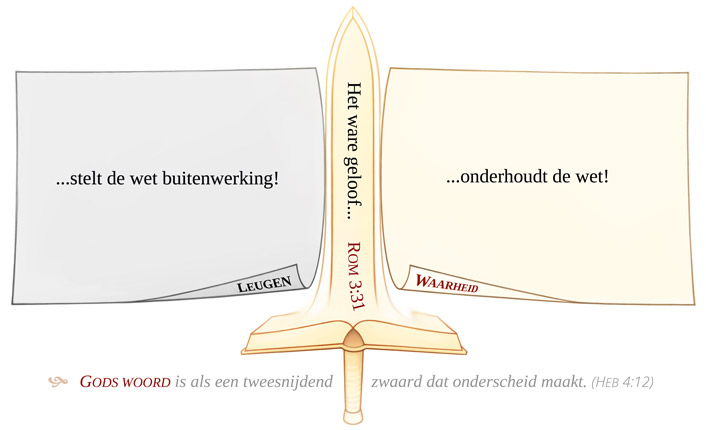
7When Paul shares his conclusion, he also poses an important question: “Do we then nullify the Law through faith?” (Rom 3:31a) What do you think? If we are not justified by works of the Law, but by faithfulness (belief), should we not observe/keep the Word of God? Paul himself answers this question with: “Absolutely not! On the contrary, we keep the Law.” If our ideas about what Paul teaches do not agree with his answer, then we know that we are misunderstanding Paul and that he means something else. In the explanation, you can find an explanation of the expression “by works of the law.”
8Paul asks this question so that the reader can check whether his understanding of Paul’s meaning is correct. If we were to conclude something different from Paul’s explanation than his answer to this question, then we would be misunderstanding him. This shows us that Paul does not want us to interpret his words as meaning that we should not obey God’s Law. Paul does not use the expression “works of the law” to warn us not to keep God’s Law. Absolutely not! The truth is the opposite. Faith without works is also dead. A believer who observes the Law is not bad, dead, or unfaithful, but rather good, alive, and faithful. Works are necessary in order not to have dead faith and not to be lost. Paul also said:
ROMANS 2:6-7 “(God) Who will repay everyone according to their deeds; to those who, by persevering in
doing good, seek glory, honor, and immortality, He gives eternal life.”
1 TIMOTHY 1:8 “…we know that the Law is good, if it is used lawfully (and not as a means of justification, for that is an unlawful use of it; God never gave His Law for that purpose).”
|
||||
| 9In Paul’s letters, he does not discuss whether or not we should obey the Law of Moses, but rather its distortions and abuses. | 3:31b Absolutely not! On the contrary, we uphold the Law (confirm/do/fulfill the Law).9 | |||
| DEATH | LIFE | |||
 Best viewed in landscape mode
| With these words from chapters 2 and 3, Paul draws a distinction between that which leads to death and that which leads to life. The contrasts Paul sets out at the beginning of his letter provide the framework within which the subsequent chapters must be reinterpreted. He contrasts the following: | |
| DARKNESS / MIX | LIGHT / PURE |
|---|---|
|

|
| DEATH | LIFE |
For further explanation, you can read the following studies…



You can click on the PDF icon to download Romans 2 & 3 with the study “works of the law” as a PDF file. You can then view it offline and print it out.