

Beloved of God,
Which words are more important of a believer to understand correctly than “repentance” and “faith“? They are two of the most essential concepts of our faith. If we don’t study them well, how easily can we be led astray and wander in deception? The spiritual war has been raging for thousands of years. We know that the enemy has been fighting against these fundamental concepts. He does everything he can to distort the truth so we will believe the lies.
This study examines the original meaning of the word that is translated as “faith” in most English Bibles. This is one of those terms that we as believers absolutely must understand correctly. Hopefully, this study will provide you with the tools to delve deeper into this subject and find confidence inthe truth.
This study is part of the book “Galatians as a Sword,” which discusses and illustrates the entire letter to the Galatians through various Bible-studies. By God’s grace, we hope to offer this book both online and in print in the future.
God bless you as you read this study.


By clicking the PDF icon you can download the full study for viewing offline or printing.
6.3 ∼ The Righteous shall Live by … ∼
As the basis for how God justifies people, Paul quotes the following words of the prophet Habakkuk:

(Galaten 3:11b BaZ) …for it is written: “The righteous shall live by ..???..”
We’ve omitted a word here at the end of the sentence, because we want to examine its meaning and translation. It’s crucial to understand this word, as it tells much about the true doctrine our justification (forgiveness of sins). Most English translations of Paul’s letters are from Greek texts. We’ll explore the meaning of the Greek word that is used. But because Paul is quoting here the Hebrew Scripture, we’ll first analyze the meaning of the Hebrew word.

6.3.1 ∼ Life through Émunâh ∼
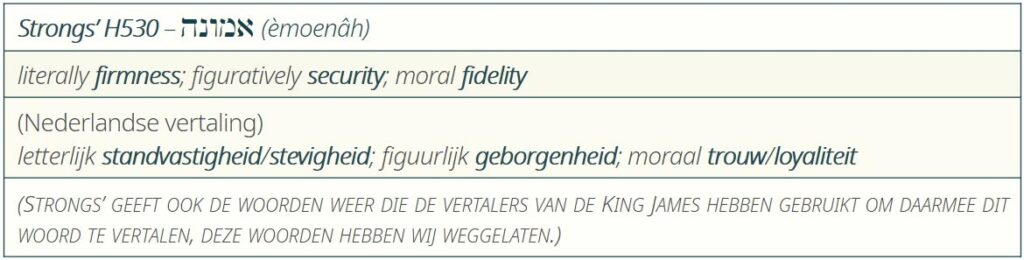
The Hebrew text of Habakuk 2:4 has the word hnwma (èmunâh) in the place that we marked with ..???… The Strongs’ Dictionary gives us the following definition:
Every word in the Hebrew language is part of a word family. To better understand a word, we have to take a look at the whole ‘word family’. Just as in a family of people, family members share similarities and characteristics with each other, so do words within a Hebrew word family. Here is an overview of the word family to which אמונה (èmunâh) belongs. This overview is from the “Ancient Hebrew Lexicon”.
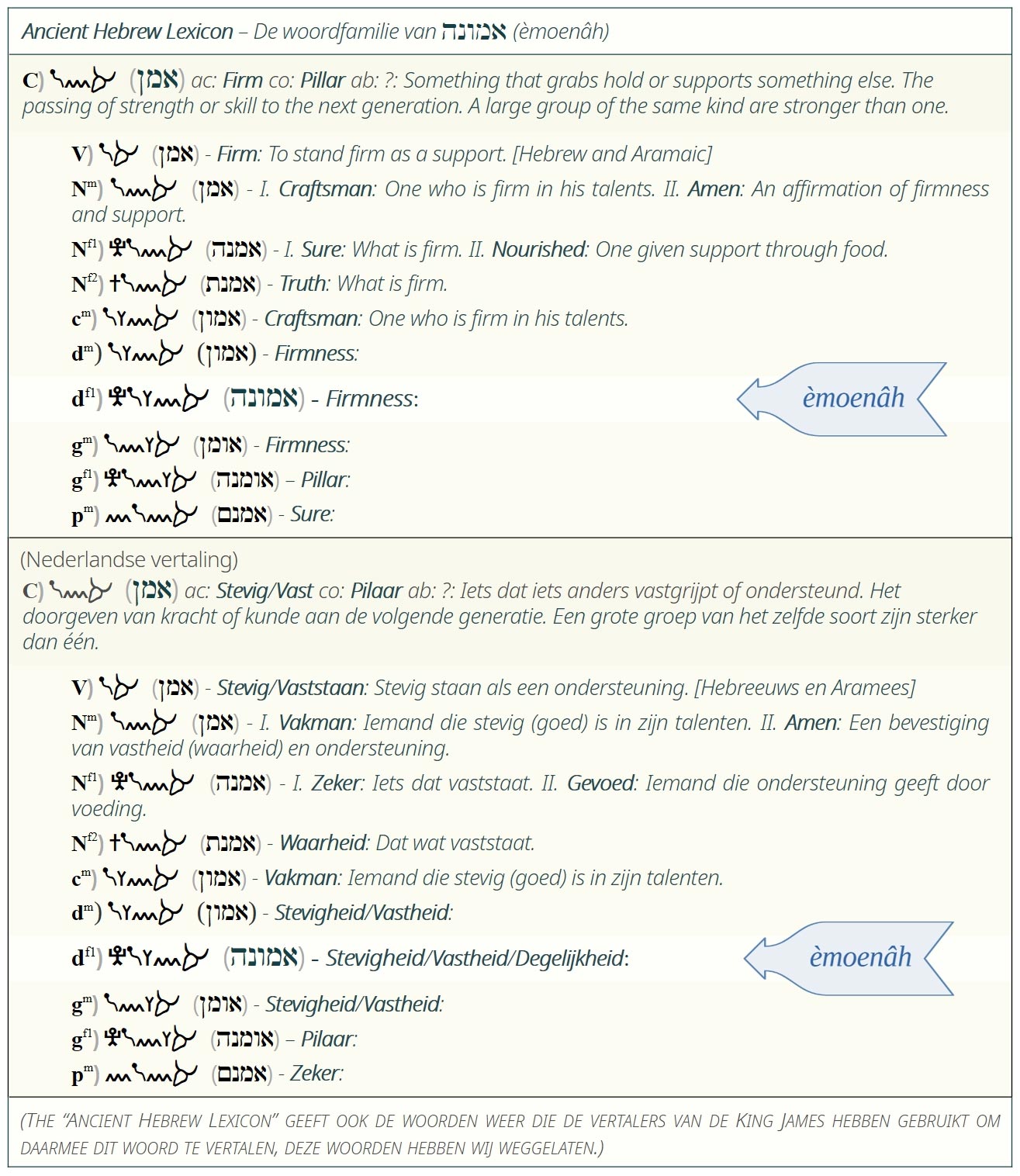
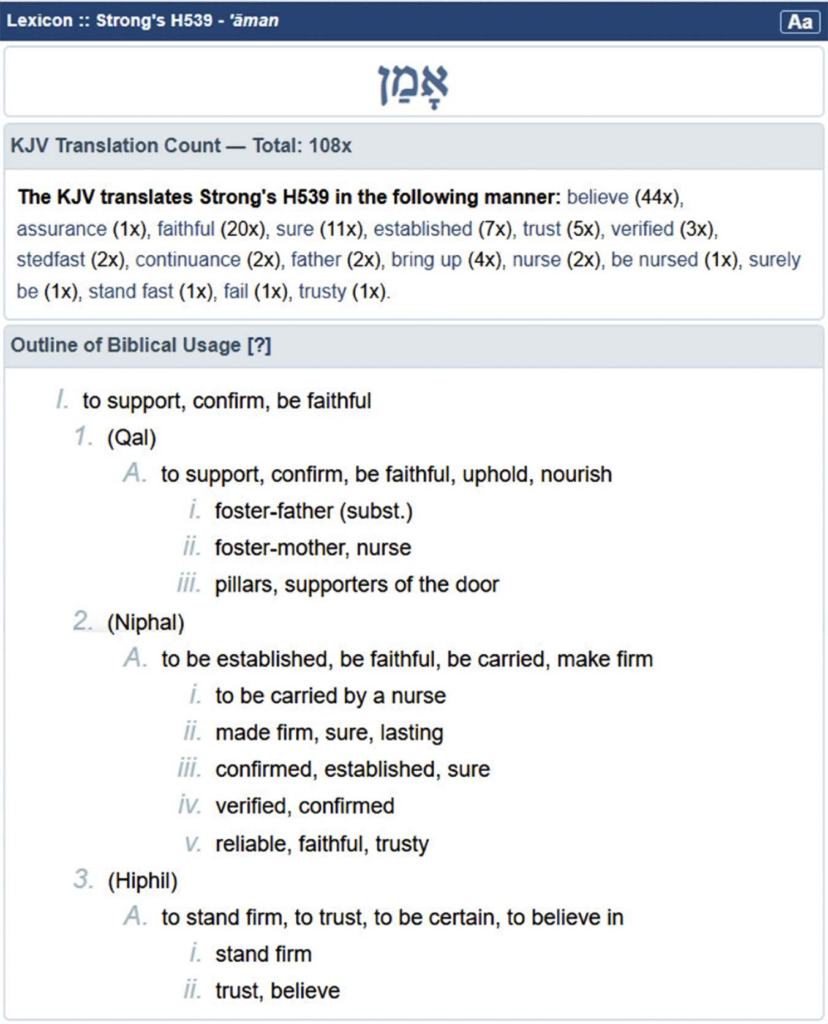
Looking at the word family of the word hnwma (èmunâh), we can see that each member shares the meaning of steadfastness/firmness/support. Just as a pillar supports a building and doesn’t move, it stands firm. Good parents that faithfully care for their children, support them with food and care. The truth is compared by God with an unmovable rock; the truth stands firm forever. (Psa 111:7-8, Psa 119:89, Jes 40:8) And like a spouse who holds fast to the marriage covenant even through temptations, that one is steadfast in their relationship. These themes we can see in the whole word family of hnwma (èmunâh). We want to note that the Hebrew word ,ma (aman), one of the words from this word-family, is, from the 108 times it appears in the Hebrew Scriptures, translated around 50 times with a word connected to faith/belief. As you can see below on the partial screenshot taken from the website: “BlueLetterBible”.
The word hnwma (èmunâh) appears about 49 times in the Torah, the Prophets, and the Writings (Tanach/OT). It is translated by the translators of the King James Version 26 times as “faithfulness/faithfully/faithful”, 15 times as “verily/truly/truth”, 2 times as “stability/steady”, 5 times as “set” and 1 time as “faith”. 48 times the translation has something to do with being “firm” and “steadfast”. So why did they translate it only in Habakkuk 2:4 as “faith”? Could translators have done this so that their translation of Habakkuk would correspond with their interpretation and translation of Paul’s words, when he quotes Habakkuk in his letters? Is there a problem if Habakkuk is actually talking about the “faithfulness” or “steadfastness” of the righteous instead of just his “faith” in the sense of trusting? By the way, not all translations translate the word hnwma (èmunâh) in Habakuk 2:4B as “faith”.
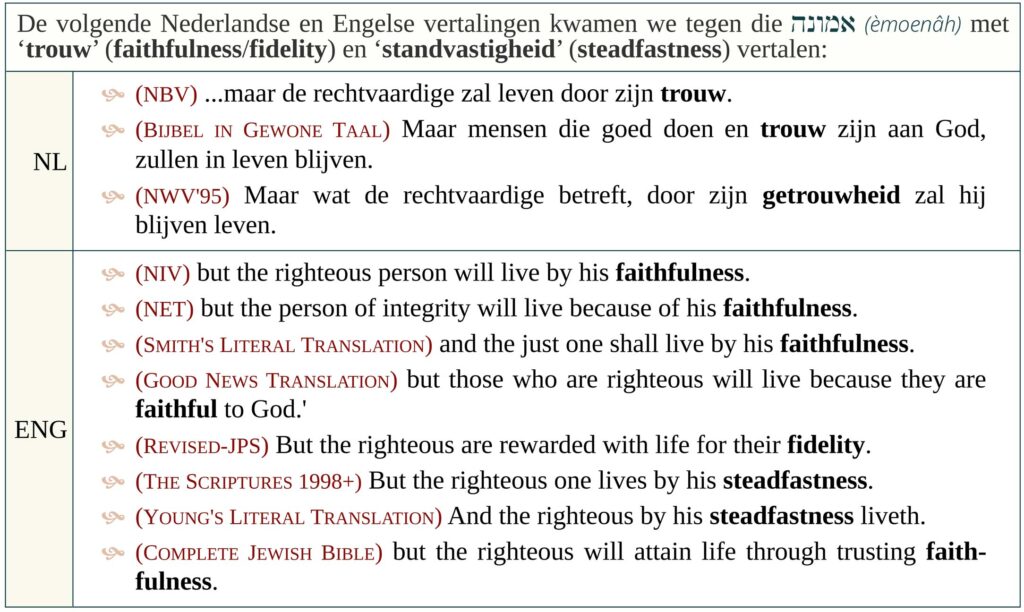
We are not against the word “faith” or think that hnwma (èmunâh) does not include the meaning of “faith”. But do the words “faith” and “loyalty” mean the same thing, or do these two words mean something different?
Because we grew up in a 20th/21st-century Western culture, our thinking and frame of reference are quite different from that of the Jewish people some 2,000 years ago, in the time of John the Baptist and the disciples of Yeshua (Jesus). This sometimes makes it very difficult to translate the Bible and accurately understand God’s message through a Bible translation. Fortunately, God does not change, and what He has written in Hebrew thousands of years ago still means the same thing. (1Sam 15:29)
Let us try to put ourselves in the time of Habakkuk. Would the king of Judah, who used the word hnwma (èmunâh) in his daily life and read the Scripture in Hebrew, have thought of a different meaning for the word hnwma (èmunâh) when the prophet Habakkuk said, “The righteous will live by hnwma (èmunâh).” Or would he have been thinking of what that word had always meant to him?
If God had wanted to communicate something different through Habakkuk than what the word hnwma (èmunâh) back then meant, wouldn’t it be strange to still use that word and not another? To communicate that the righteous lives by their “faith”, as in, by their trusting, He could have used a word like jfbm (mibṭâch) / jfb (bâṭach), or hsj (chasah) words which carry the meaning of trust/trusting. (Eze 29:16, Pro 22:19, Jer 17:5, Isa 36:4 & 59:4, 2Sam 22:3, Psa 2:12 &118:8) But looking at the overall message of God to His people trough the prophets, the message is clearly not only about trust but also about faithfulness. When we have to communicate a important teaching on which eternal life depends, we choose words that the people we are communicating with understand in the same way. Therefore, we must try to find the meaning of the word hnwma (èmunâh) as it had in the time of Habakkuk.
The Bible itself can be used as a dictionary. This can be done by examining the context in which the word is used. We can also consult extrabiblical writings from that period, but generally, the Bible itself often provides sufficient insight trough the context. Because the Bible is the word of God, it is very trustworthy, but, since the lexicons are the work of humans, it must be tested by the Scriptures to make sure their conclusions are correct.
The first time a word appears in the Bible often turns out to be a unique moment that God
uses to reveal something about its meaning. The first time the word hnwma (èmunâh) appears in Scripture is in Exodus 17:

(Exodus 17:11-12 KJV) And it came to pass, when Moses held up his hand, that Israel prevailed: and when he let down his hand, Amalek prevailed. But Moses’ hands were heavy; and they took a stone, and put it under him, and he sat thereon; and Aaron and Hur stayed up his hands, the one on the one side, and the other on the other side; and his hands were steady (אמונה èmoenâh) until the going down of the sun.
The word hnwma (èmunâh) here describes how Moses’ hands were held steady until sunset. When his hands would go down Israel would lose the battle. Moses’ hands had to remain faithfully in their position. Through this event, God gives us a concrete picture of what hnwma (èmunâh) means.
The following psalm speaks about God’s hnwma (èmunâh) and places it in a context which speaks about building up and establishing for ever and it speaks of not altering or breaking the covenant to David, these things are telling us something about the meaning of the word hnwma (èmunâh).
(Psalm 89:1-5 & 34-35 NKJV) I will sing of the mercies of the LORD forever; With my mouth will I make known Your faithfulness (hnwma èmunâh) to all generations. For I have said, “Mercy shall be built up forever; Your faithfulness (hnwma èmunâh) You shall establish in the very heavens.” “I have made a covenant with My chosen, I have sworn to My servant David: ‘Your seed (the Son of David/the Messiah) I will establish forever, And build up your throne to all generations (forever).’ ” Selah And the heavens will praise Your wonders, O LORD; Your faithfulness (hnwma èmunâh) also in the assembly of the saints. […] But My lovingkindness I will not take away from him, nor will I fail in My faithfulness (hnwma èmunâh). I will not break My covenant, nor alter the thing that has gone out of My lips (it stands firm forever).
In several places, Scripture also speaks of the אמונה (èmoenâh) of God. (Lam 3:23, Psa 134:1, Isa 33:6, Psa 119:75)
(Isaiah 25:1 JPS) O LORD, Thou art my God, I will exalt Thee, I will praise Thy name, for Thou hast done wonderful things; even counsels of old, in faithfulness (hnwma èmunâh) and truth.
(Psalm 119:90 PNB-YLT-1) Your faithfulness (hnwma èmunâh) endures to generation and generation; You founded the earth, and it stands.
In the previous verse the context describes something of the meaning of the word אמונה (èmoenâh) as it refers to the earth being founded and standing firm. (Psa 104:5) The next Bible verses place אמונה (èmoenâh) in the context of work being done that a king had commended.
(2 Chronicles 34:10, 12a & 16 NKJV) Then they put it (the money) in the hand of the foremen who had the oversight of the house of the LORD; and they gave it to the workmen who worked in the house of the LORD, to repair and restore the house. […] And the men did the work faithfully אמונה (èmoenâh). […] So Shaphan carried the book to the king, bringing the king word, saying, “All that was committed to your servants they are doing.
Now, when addressing a congregation to answer specific questions, does it make sense to quote a text that the addressees do not know and whose context they are unfamiliar with? No, that doesn’t makes sense. So it is also important for us to know the context of Habakkuk 2:4 if we want to understand Paul properly when he is quoting it in his letters. So let’s look at the immediate context of Habakkuk 2:4 to see what it is talking about:
 Best bekeken in liggende modus
| HABAKKUK 2:4-8 (TS 1998+) |
|
|---|---|
| THE ONRIGHTEOUS | THE RIGHTEOUS |
| 4a “See, he whose being is not upright in him is puffed up1… | 1These things make a person unrighteous. |
| 2In the time of Habakkuk it was clearly understood that a righteous person is someone who does what is right and just in God’s eyes. | 4b …But the righteous one2 lives by his ..???… |
| 5 “And also, because wine betrays him, a man is proud3, and he does not stay at home. Because he enlarges his appetite as the grave, and he is like death, and is not satisfied, and gathers to himself all nations and heaps up for himself all peoples. | 3The text is no longer speaking about the righteous but is speaks again of him whose being is not upright. (verse 4a) Like the new Jerusalem (the Bride) and Babylon (the whore) exist of a group of people so the “him” mentioned here can also point to a group of people, the unrighteous. |
| 6a “Shall not all these lift up a proverb against him, and a mocking riddle against him, and say, | |
| 6b ‘Woe to him who increases what is not his!4 Till when is he to load on himself many pledges’? | 4Whoever does this, is unjust and not the righteous one mentioned in verse 4b. |
| 7 “Do not your creditors rise up suddenly? And those who make you tremble wake up and you be plunder for them? | |
| 8 “Because you have plundered many nations, all the remnant of the people shall plunder you, because of men’s blood, and doing violence to the land, to the city, and to all who dwell in it. | |
| DEAD | LIFE |
In the King James Version, verses 4 and 5a read as follows:
(Habakkuk 2:4-5a KJV) Behold, his soul which is lifted up is not upright in him: but the just shall live by his ..???… Yea also, because he transgresseth (deals unfaithfully) by wine, he is a proud man…
We see that the context of Habakuk 2:4 contrasts the righteous with the unrighteous, those who do what is right and just in God’s sight, versus him who is insincere and unfaithful. The writer of Hebrews also makes this distinction when he quotes Habakuk 2:4.
Best bekeken in liggende modus| HEBREWS 10:36-38 BaZ |
|
|---|---|
| THE ONRIGHTEOUS | THE RIGHTEOUS |
| 36 For you need endurance, so that after you have done the will of God, you may receive the promise. 37 For not long and He who is to come will come and no more delay.1 | |
| 1Yeshua will judge in God’s name, who will receive the promise with eternal life and who will not. | |
| 2A person is righteous in God’s sight when he repents from what is unrighteous and does what is right. | 38a Now, the righteous2 shall live by ..???.., |
| 38b …but if he draws back3, My soul shall have no pleasure in him.4 | 3Becomes negligent / lukewarm in doing God’s will and does not endure to the end.(2Pet 2:20-22, Heb 6:4-6, Rev 3:16) 4He shall perish and not receive eternal life. (See next verse and Isa 1:4, Jer 14:12, Jer 15:6, Acts 10:34-35) |
| 5The destruction in hell, the second death. 6(Rom 6:16) Receiving the promise, which includes eternal life. | 39 But we are not of those who draw back [which leads] to destruction,5 but are of ..???.. [which leads] to the saving6 of the soul. |
| DEAD | LIFE |
With these words the writer points out that the righteous must not become negligent, but must persevere in doing God’s will. That is why verse 36 talks about endurance, in doing the will of God. (Mat 7:21, Heb 12:1) This clearly speaks about being faithful/loyal/steadfast. In Luke we also read that Yeshua passes this message on to His followers:
(Lukas 21:19 NET) By your endurance you will gain your lives.
So we see that Habakkuk, as well as the writer of Hebrews, contrast the righteous with the unrighteous.
If we summarize the characteristics of the unrighteous and the righteous (according to Habakkuk and
what is written in Hebrews), we see the following.
Best bekeken in liggende modus| THE ONRIGHTEOUS | THE RIGHTEOUS |
|---|---|
| The one who is not upright, proud, increases what is not his and draws back into unrighteousness. | The one who perseveres in doing what is right and does not draw back. |
I was looking in the Bible to see if hnwma (èmunâh) is ever placed in a context which speaks of trust, but I did not find it. When we look at the immediate context in witch the writer of Hebrews palaces the word hnwma (èmunâh)1. We see that it does not speak of trust or a belief in something, but rather of faithfulness. The immediate context provides no reason why hnwma (èmunâh) should be translated here as simply ‘faith’. And why would God, in Habakkuk 2:4, not use hnwma (èmunâh) to speak of the steadfastness/faithfulness of the righteous? Or did God perhaps want to teach His people a new way to life through Habakkuk? Or did He send Habakkuk to call the people to repent of their unfaithfulness and remind them again of the true way to life? In a slightly different way than through Habakkuk, God expresses the same message through Ezekiel, that the righteous will live by their faithfulness:
(Ezechiël 18:5 & 9 LITV-TSP) But a man that is righteous and does what is just and right, […] He has walked in My statutes and has kept My judgments to deal truly (אמת emet)1; he is righteous. Surely he shall live, declares the Lord Jehovah.
(1 Samuel 26:23a KJV) The LORD render to every man his righteousness and his faithfulness (hnwma èmunâh):
God teaches nothing different through Ezekiel than through Habakkuk. He did not and does not contradict Himself. Both prophets complement each other, enabling us to better understand God’s message. Through multiple witnesses, we can also build on His word as on a rock. For only trough multiple witnesses can a matter be established. (Deu 19:15, 2Cor 13:1, Matt 18:16)
Wouldn’t it be strange and confusing if God taught something different through one prophet than through another? His people would then be divided, because each person would have to choose for themselves which of the paths appointed by God they would follow in order to attain life. The Almighty is a God of order, not confusion. He is perfect, and His plans do not fail. (Deu 32:4, Psa 102:28, Mat 5 :48 & 19:17 & 26, 1Sam 15:29, Jes 26:4, Mal 3 :6, Num 23:19, Rom 1:9, Jam 1:17, Mar 10:27 & 14:36) He did not create different doctrines of faith, He testifies of one way and one truth.
| The following quote is from Rabbi Jonathan Sacks, “Leadership and Loyalty.” (Seffer.org) |
| The Hebrew word emunah is usually translated as “faith,” and that is what it came to mean in the Middle Ages. (He is probably talking about his current culture.) But in biblical Hebrew it is better translated as “faithfulness, reliability, loyalty.” It means not walking away from the other party when times are tough. It is a key covenantal virtue. There are people with great gifts, intellectual and sometimes even spiritual, who nonetheless fail to achieve what they might have done. They lack the basic moral qualities of integrity, honesty, humility, and above all, loyalty. What they do, they do brilliantly. But often they do the wrong things. Conscious of their unusual endowments, they tend to look down on others. |
If we let the Bible define the word hnwma (èmunâh), we see that it speaks of “steadfastness” and “faithfulness”. This isn’t to say that “faith” or “believing” isn’t part of its meaning. Because to be faithful one must also have faith. But according to our research, of the 49 times the word appears in Scripture, the context doesn’t speak of only “trusting/believing” even once. If our goal is to translate God’s message through the prophet Habakkuk as accurately and clearly as possible, wouldn’t it be best to do so in line with the rest of the prophets? Or would we rather translate it differently based on a personal theological preference?
6.3.2 ∼ Life through Pistis ∼
Most Bible translations of the apostles’ writings (NT) are done from Greek. The places where Paul quotes Habakkuk, the Hebrew word אמונה (èmoenâh) is replaced by a conjugation of the Greek word πίστις (pistis). In the Aramaic text, the word הימנותא (haymanoeta) appears in these places. In this study, we will not discuss Aramaic, but we would like to state that, in our view, the meaning of הימנותא (haymanoeta) is similar to the Greek word πίστις (pistis).
Now, in the time of Yeshua and the apostles, a Greek translation of the Hebrew writings of Moses and the prophets had already been made, called the Septuagint (LXX). In this translation the word אמונה (èmoenâh) in Habakkuk 2:4 is translated with the Greek word πίστις (pistis). Here are some other Bible verses in which אמונה (èmoenâh) is translated with πίστις (pistis) in the LXX:
(2 Chronicles 31:15 & 16b LITV-TSP) And by his hand, Eden, and Miniamin, and Jeshua, and Shemaiah, Amariah, and Shecaniah, in the cities of the priests, faithfully (èmunâh Heb..2| pistis LXX) to give to their brothers by divisions, as to the great, so to the small; […] the proper portion of a day in its day, for their service in their duties, according to their divisions;
(2 Chronicles 34:12a KJV) And the men did the work faithfully (èmunâh Heb.| pistis LXX):
(2 Kings 22:7 KJV) Howbeit there was no reckoning made with them of the money that was delivered into their hand, because they dealt faithfully (èmunâh Heb.| pistis LXX).
(Hosea 2:19 LITV-TSP) I will even betroth you to Me in faithfulness (èmunâh Heb.| pistis LXX). And you shall know Jehovah..
(Proverbs 12:22 NET) The LORD abhors a person who lies, but those who deal truthfully (èmunâh Heb.| pistis LXX) are his delight.
The word πίστις (pistis) is also used by the LXX to translate other words from the same word-family as אמונה (èmoenâh), but never a word like מבטח (mibṭâch) / בטח (bâṭach) or חסה (chasah) which are words that are translated with “trust.”
(Nehemiah 9:38 SV) En in dit alles maken wij een vast verbond (ămânâh Heb.| pistis LXX) en schrijven het; en onze vorsten, onze Levieten en onze priesteren zullen het verzegelen.
(Deuteronomium 32:20 SV) En Hij zeide: Ik zal Mijn aangezicht van hen verbergen; Ik zal zien, welk hunlieder einde zal wezen; want zij zijn een gans verkeerd geslacht, kinderen, in welke geentrouw(êmûn Heb.| pistis LXX) is.
(Spreuken 3:3-4 NBG’51) Dat liefde en trouw (emeth Heb.| pistis LXX) u niet verlaten! Bind ze om uw hals, schrijf ze op de tafel van uw hart, Dan zult gij genegenheid en goedkeuring verwerven in de ogen van God en mensen.
(Jeremiah 32:41 SV) En Ik zal Mij over hen verblijden, dat Ik hun weldoe; en Ik zal hen getrouwelijk (emeth Heb.| pistis LXX) in dat land planten, met Mijn ganse hart en met Mijn ganse ziel.
De Septuaginta (LXX) laat zien dat het Griekse woord πίστις (pistis) in die tijd gebruikt werd om het het Hebreeuwse woord אמונה (èmoenâh) te vertalen naar het Grieks, en dat πίστις (pistis) niet hoofdzakelijk ‘geloof’ betekent, maar ook ‘trouw / standvastigheid / loyaliteit’. Maar waarom heeft men dan het woord πίστις (pistis) in de geschriften van de apostelen standaard vertaald met ‘geloof’ op een enkele uitzondering na?
Op de volgende twee plaatsen wordt πίστις (pistis) in de NBG’51 en de HSV vertaald met trouw:
(Titus 2:9-10 NBG’51) De slaven moeten hun meesters onderdanig zijn in alles, het hun naar de zin maken zonder tegenspraak, of oneerlijkheid (ontrouw), maar alle goede trouw (πίστις pistis) bewijzen, om de leer van God, onze Heiland, in alles tot sieraad te strekken.
(Romeinen 3:3b NBG’51)Als sommigen ontrouw geworden zijn, zal dan hun ontrouw de trouw (πίστις pistis) Gods tenietdoen?
Het zou niet gepast zijn geweest als op deze twee plaatsen πίστις(pistis) vertaald was met ‘geloof’. Omdat God niet ergens in moet geloven betekent πίστις (pistis) hier duidelijk: trouw. Ontrouw wordt in deze verzen ook tegenover πίστις (pistis) gezet. Dat πίστις (pistis) ook in de geschriften van de apostelen (NT) de betekenis van trouw met zich meedraagt, daarvan getuigt ook het bijvoeglijke naamwoord πιστός (pistos), een woord dat deel is van dezelfde woordfamilie. Enkele voorbeelden hiervan uit de Bijbel zijn:
(Lukas 16:10 SV) Die getrouw (πιστός pistos) is in het minste, die is ook in het grote getrouw (πιστός pistos); en die in het minste onrechtvaardig is (wat ontrouw is), die is ook in het grote onrechtvaardig.
(1 Korinthe 7:25b HSV) Ik geef echter mijn mening als iemand die barmhartigheid van de Heere heeft gekregen om trouw (πιστός pistos) te zijn.
(Lukas 12:42-46 HSV) En de Heere (Jesjoea) zei: Wie is dan de trouwe (πιστός pistos) en verstandige rentmeester(gelovige), die de heer over zijn huisbedienden zal aanstellen om aan hen op de juiste tijd het voedsel te geven dat hun toekomt? Zalig de slaaf (gelovige) die door zijn heerbij zijn komst (tweede komst van Jesjoea) zo handelend aangetroffen zal worden (als een trouwe en verstandige rentmeester). Werkelijk, Ik zeg u dat hij hem over al zijn bezittingen zal aanstellen(het koninkrijk beërven). Als die slaaf (gelovige) echter in zijn hart zou zeggen: Mijn heer blijft nog lang weg, en zou beginnen de knechten en de dienstmeisjes te slaan, te eten en te drinken en dronken te worden, dan zal de heer van deze slaaf (gelovige) komen op een dag waarop hij hem niet verwacht, en op een uur dat hij niet weet; en hij zal hem in stukken houwen en hem in het lot doen delen van hen die ontrouw (ἄπιστος a-pistos) zijn(de tweede dood, de hel).
(1 Korinthe 4:2 BaZ) …verder is het vereist van elke beheerder dat hij getrouw (πιστός pistos) wordt bevonden.
(1 Timotheüs 3:11 HSV) De vrouwen moeten evenzo eerbaar zijn, geen kwaadspreeksters, beheerst, trouw (πιστός pistos)in alles.
(Openbaring 2:10b-11 HSV) Wees trouw (πιστός pistos) tot in de dood, en Ik zal u de kroon van het leven geven. Wie oren heeft, laat hij horen wat de Geest tegen de gemeenten zegt. Wie overwint, zal zeker geen schade toegebracht worden door de tweede dood (de hel).
(Openbaring 19:11a HSV) En ik zag de hemel geopend, en zie, een wit paard, en Hij Die daarop zat, werd getrouw (πιστός pistos) en waarachtig genoemd.
Zowel het zelfstandige naamwoord πίστις (pistis) als het bijvoeglijke naamwoord πιστός (pistos) dragen een bredere betekenis dan alleen trouw. Ze bevatten ook de betekenis van geloof / vertrouwen en het zweren van loyaliteit. Voor meer informatie over de betekenis en hoe het woord πίστις (pistis) en verwante woorden werden gebruikt in de tijd en cultuur van toen, kun je de volgende Engelse boeken lezen: “Salvation by allegiance alone” geschreven door Matteüs W. Bates of het boek, “Citizenship: Paul on Peace and Politics” geschreven door Gordan Mark Zerbe.
| Hieronder een citaat uit het boek “Citizenship: Paul on Peace and Politics”, (blz. 34), om een idee te geven van de conclusie waar de schrijver van het boek op uit is gekomen. Het citaat is in het Engels met daaronder een Nederlandse vertaling. |
| As elsewhere in Greek discourse, pistis and cognate words in Paul’s letters have a remarkable polyvalence and range. Sometimes a specific use of pistis incorporates a broad range of senses that cannot be easily rendered in English, and sometimes a use highlights a particular sense of pistis. There are two key problems, however, in properly rendering Paul’s language of pistis and pisteuein into English. (a) English lexically separates faith from faithfulness, and trust from trustworthiness. To truly render the full sense of pistis in many instances, one should really use a hyphenated neologism like “loyalty-faith,” or “faith / fidelity,” or a phrase such as “loyal faith,” or “faithful trust.” (b) English has no corresponding verb for the nouns “faith” or “loyalty,” in the same way that “believe” is a counter-part to “belief.” Nor does the verb “trust” have a corresponding participle “truster,” in the way that “believe” has the rendering “believer.” But we do have a word for people who are loyal, “loyalists,” and in most instances, that is a far better rendering of Paul’s meaning than the translation “believers.” While Paul does sometimes use pistis and pisteuein with the primary connotations of “belief” and “believe,” these are minority examples, and not at the core of his proclamation. But in accordance with longstanding tradition, English translations still regularly supply “believe” when the meaning is actually “to trust,” or a combination of “to trust and be loyal,” or a blend of “to believe, trust, and be loyal.” Or, English translations supply “believers,” when the meaning is “those who trust and are faithful,” “those who trust and obey,” or “those who declare allegiance.” |
| Hieronder een Nederlandse vertaling: Zoals elders in het Griekse spreken, hebben pistis en verwante woorden in Paulus’ brieven een opmerkelijke veelzijdigheid en reikwijdte. Soms omvat een specifiek gebruik van pistis een breed scala aan betekenissen die niet gemakkelijk in het Engels (en Nederlands) kunnen worden weergegeven, en soms benadrukt een gebruik (van het woord) een bepaalde betekenis van pistis. Er zijn echter twee belangrijke problemen bij het correct weergeven van Paulus’ taalgebruik van pistis en pisteuein in het Engels (dit komt aardig overeen met het Nederlands). (a) Het Engels scheidt lexicaal geloof van trouw, en vertrouwen van betrouwbaarheid. Om de volledige betekenis van pistis in veel gevallen echt weer te geven, zou men eigenlijk een neologisme met koppelteken moeten gebruiken, zoals “loyalty-faith” (loyaliteit-geloof), of “faith / fidelity” (geloof / trouw), of een zin zoals “loyal faith” (loyaal geloof), or “faithful trust” (getrouw vertrouwen). (b) Het Engels heeft geen overeenkomstig werkwoord voor de zelfstandige naamwoorden “faith” (geloof) of “loyalty” (loyaliteit), op dezelfde manier dat “believe” (geloven) een tegenhanger is van “belief” (geloof). Het werkwoord “trust” (vertrouwen) heeft ook geen overeenkomstig deelwoord “truster” (vertrouwer), zoals “believe” (geloven) de weergave “belie-ver” (gelovige) heeft. Maar we hebben wel een woord voor mensen die loyaal zijn, “loyalists” (loyalen / getrouwen), en in de meeste gevallen is dat een veel betere vertaling van Paulus’ betekenis dan de vertaling “believers” (gelovigen). Hoewel Paulus soms pistis en pisteuein gebruikt met de hoofdzakelijke connotaties (betekenis) van “belief” (een geloof) en “believe” (geloven), is dit de minderheid en niet de kern van zijn verkondiging. Maar in overeenstemming met de langdurige traditie, geven Engelse (en Nederlandse) vertalingen nog steeds regelmatig “believe” (geloven) weer wanneer de betekenis eigenlijk “to trust” (vertrouwen) is, of een combinatie van “to trust and be loyal” (vertrouwen en trouw zijn), of een mengvorm van “to believe, trust, and be loyal” (geloven, vertrouwen en loyaal zijn). Of, Engelse vertalingen geven “believers” (gelovigen) weer, wanneer de betekenis is “these who trust and are faithful” (zij die vertrouwen en trouw zijn), “these who trust and obey” (zij die vertrouwen en gehoorzamen) of “these who declare allegiance” (zij die loyaliteit verklaren). |
| Hieronder een citaat uit het boek “Salvation by allegiance alone”, (blz. 5), om een idee te geven van de conclusie waar de schrijver van het boek op uit is gekomen. Het citaat is in het Engels met daaronder een Nederlandse vertaling. |
| With regard to eternal salvation, rather than speaking of belief, trust or faith in Jesus, we should speak instead of fidelity to Jesus as cosmic Lord or allegiance to Jesus the king. This, of course, is not to say that the best way to translate every occurrence of pistis (and related terms) is always or even usually “allegiance.” Rather it is to say that allegiance is the best macro-term available to us that can describe what God requires from us for eternal salvation. It is the best term because it avoids unhelpful English-language associations that have become attached to “faith” and “belief,” as well as limitations in the “trust” idea, and at the same time it captures what is most vital for salvation—mental assent, sworn fidelity, and embodied loyalty. |
| Hieronder een Nederlandse vertaling: Met betrekking tot de eeuwige zaligheid (onze uiteindelijke redding), in plaats van te spreken van overtuiging, vertrouwen of geloof in Jezus, zouden we in plaats daarvan moeten spreken over trouw aan Jezus als kosmische Heer of trouw aan Jezus de koning. Dit, natuurlijk, wil niet zeggen dat de beste manier om elk voorkomen van pistis (en aanverwante termen) altijd te vertalen is, of zelfs meestal, met “trouw” (allegiance / gezworen trouw). Het is eerder om te zeggen dat trouw de beste beschikbare macro-termijn is voor ons, die beschrijft wat God van ons verlangt voor de eeuwige zaligheid. Het is de beste term omdat het onhandige Engelstalige (en ook Nederlandstalige) associaties voorkomt die gehecht zijn geraakt aan “geloof” en “geloven,” evenals de beperkingen rond het begrip van “vertrouwen”, en tegelijkertijd geeft het dat weer, wat het meest van vitaal belang is voor de zaligheid—mentale instemming, gezworen trouw en belichaamde loyaliteit. |
Voor meer duidelijkheid over hun onderzoek kun je deze boeken lezen.
De geschiedenisboeken van de Makkabeeën en Flavius Josephus dragen bij in het begrijpen van wat πίστις (pistis) betekende in en rond de tijd van de apostelen.
- (1 Makkabeeën 10:25b-27 Willibrordvertaling) Koning Demetrius aan het volk van de Joden. Heil! Wij hebben met vreugde vernomen dat u de met ons gesloten verdragen bent nagekomen, de vriendschap met ons bent trouw gebleven en u niet hebt aangesloten bij onze vijanden. Blijf ook nu in uw trouw (πίστις pistis) jegens ons volharden; wij zullen alles wat u voor ons doet met weldaden vergelden,
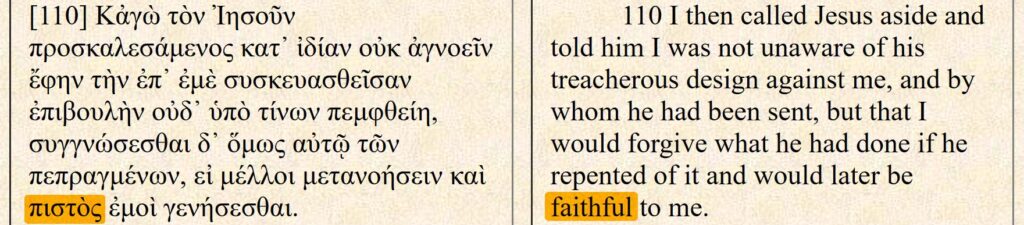
“Volhard in uw πίστις(pistis)” klinkt als een oproep uit de Bijbel. Maar vraagt koning Demetrius hier om het geloof van de Joden, of om hun loyaliteit / trouw? In de tijd van de apostelen was er een Joodse generaal genaamd Josephus. In de Griekse tekst van “The Life of Flavius Josephus” komt het woord pistis / pistos in verschillende vervoegingen voor en wordt daarmee hoogstwaarschijnlijk altijd trouw / loyaliteit bedoeld. Hier volgen een paar citaten met een Engelse vertaling er naast.



In het volgende voorbeeld gaat het niet om Jezus (Jesus) uit Nazareth, maar een rebelleider met de zelfde naam. Deze rebelleider wordt door Josephus opgeroepen om zich te bekeren en loyaliteit / trouw te bewijzen.
| Hieronder een vertaling van het Engels naar het Nederlands. |
| 110 Toen riep ik Jezus apart en vertelde hem dat ik niet onwetend was van zijn bedrieglijke plannen tegen mij, en door wie hij gezonden was, maar dat ik hem vergeven zou van wat hij had gedaan als hij zich zou bekeren daarvan en daarna ook getrouw zou zijn aan mij. |
Als dit de woorden van Koning Jesjoea waren geweest, zouden de Bijbelvertalers waarschijnlijk een vertaling hebben overwogen zoals: “bekeer je en geloof in Mij”. Als nu Josephus als generaal niet vraagt om geloof, maar om trouw / loyaliteit, waarom zou de Koning boven alle koningen dan niet van zijn volk vragen om trouw / loyaliteit in plaats van enkel geloof?
Verplaats je eens in de mensen die toen leefden in het Midden-Oosten, aan de ene kant vroegen aardse koningen van hen hun πίστις (pistis) en aan de andere kant vroeg de hemelse Koning van hen hun πίστις (pistis). Zouden ze dan bij de ene koning denken aan ‘geloof’ en bij de ander aan ‘trouw’ terwijl ze hetzelfde woord gebruiken?
Christus is geen achternaam, maar een titel. Christus is een Grieks woord dat gezalfde betekent, zoals messias in het Hebreeuwse gezalfde betekent. Wanneer de Bijbel Jesjoea, de Gezalfde (Christus / Messias) noemt, dan verwijst het naar Zijn zalving tot Koning en Hoge-priester over Gods koninkrijk en volk. En omdat een belangrijk deel van het evangelie draait om de beloofde Zoon van David, Die Gods koninkrijk hier op aarde voor eeuwig zal vestigen en Gods volk zal bevrijden van elke vijand door alle koninkrijken van de wereld weg te vagen, is het logisch dat deze goede boodschap gepaard gaat met de oproept om niet langer in vijandschap met God te leven. We worden geroepen ons te bekeren van onze zonden, ons vertrouwen op God en Zijn Gezalfde te stellen, en Hem loyaal / trouw te zijn tot het einde. (Open 2:10, Lukas 6:46) Dit is de context van het evangelie waarin wij worden opgeroepen door God om onze πίστις (pistis) te geven. Deze oproep gaat duidelijk verder dan alleen ons ‘geloof’ (overtuiging / vertrouwen) in dat Jesjoea Gods Gezalfde is en voor onze zonden is gestorven.
Door πίστις (pistis) standaard en bijna uitsluitend te vertalen met ‘geloof’ wordt er van de duidelijke verwijzing naar de trouw / loyaliteit aan God en Zijn gezalfde Koning verwijderd, waardoor de focus verlegt wordt op alleen geloven (overtuiging / vertrouwen). Er ontstaat hierdoor een vertekend beeld van waar het evangelie ons toe oproept, waardoor mensen schuin gaan in hun denken en dwalingen geloven; dat alleen geloven zonder werken (trouw) voldoende zou zijn om Gods koninkrijk binnen te mogen gaan. Dit gaat echter tegen de waarheid in. (Jak 2:24)
Terugkomend op de vraag: Vinden we het belangrijk om correct te verstaan, waaruit de rechtvaardige zal leven? Omdat de context rond Habakuk 2:4, en wanneer dit vers geciteerd wordt in de Hebreeën brief, spreekt over trouw en ontrouw, lijkt het ons correct, om op die plaatsen אמונה (èmoenâh), πίστις (pistis) of het Aramese woord הימנותא (haymanoeta) te vertalen met een woord dat verwijst naar ‘trouw / loyaliteit’ en niet alleen naar ‘geloof’. Hiermee willen we niets afdoen van het feit dat πίστις (pistis) of het Aramese woord הימנותא (haymanoeta) ook de betekenis van geloof met zich meedraagt. Maar omdat binnen de huidige Nederlandse taal en cultuur ‘geloof’ en ‘trouw’ als twee aparte begrippen worden gezien, wordt de lezer niets verteld over het aspect van trouw / loyaliteit, wanneer het naar het Nederlands vertaald wordt met alleen het woord ‘geloof’. Wij hebben er daarom voor gekozen om in Galaten 3:11, πίστις (pistis) en הימנותא (haymanoeta) te vertalen met ‘geloofstrouw’. Een woord waarmee we proberen te verwijzen naar meer van de complete betekenis van deze woorden. Met ‘geloofstrouw’ verwijzen we naar een loyaliteit of trouw die gegeven wordt omdat diegene is gaan geloven. Een volkomen toewijding in trouw, die gezworen wordt en vaststaat vanwege een overtuiging en een vertrouwen. Met het woord ‘geloofstrouw’ verwijzen wij dus naar beiden, geloven en het trouw zijn.

Door hoofdzakelijk אמונה (èmoenâh) te vertalen met ‘trouw’ en πίστις (pistis) met ‘geloof’, lijkt God een ander evangelie te verkondigen door de wet en de profeten (OT) dan door de Griekse tekst van de geschriften van de apostelen (NT). Eén voor de dood en opstanding van Jesjoea; waarin God het leven belooft aan wie trouw zijn, en een ander evangelie daarna; waarin God de focus zou hebben veranderd naar geloven los van onze trouw / wandel / werken. Maar dit blijkt niet waar te zijn wanneer we dieper graven naar de waarheid. Het evangelie waar ook Jesjoea Zich voor inzette en dat Hij verkondigde voor Zijn dood, veranderde niet erna. De woorden אמונה (èmoenâh), πίστις (pistis) en הימנותא (haymanoeta) zijn niet met de dood van Jesjoea veranderd van betekenis. Voor de dood en opstanding van Jesjoea schonk God, de rechtvaardige, het leven door אמונה (èmoenâh) en nu erna nog altijd. Of je moet van mening zijn dat Paulus de woorden van Habakuk anders bedoelt dan Habakuk zelf. Maar als dat waar zou zijn, dan zou dat betekenen dat Paulus de woorden van Habakuk niet naar waarheid citeert, maar die verdraait.
De Allerhoogste is geen God die soms een foutje maakt en Hij spreekt Zichzelf ook niet tegen. Hij heeft één evangelie, één weg die naar het leven leidt, en één deur om Zijn koninkrijk binnen te gaan.3 (Heb 4:2, 6, 1Kor 10:4)
Begrijp ons niet verkeerd, wij zijn niet tegen het woord ‘geloof’ of ‘geloven’. Willen we leven, dan moeten we zeker geloven, maar als we Gods Gezalfde willen volgen en het leven binnengaan, dan moeten we ook trouw zijn aan de Koning. Met betrekking tot de oproep waarmee de Koning ons roept, willen we nogmaals kijken naar hoe de schrijver van de Hebreeën brief Habakuk 2:4 citeert.
(Hebreeën 10:36-39 BaZ) Want jullie hebben volharding nodig, om door de wil van God te volbrengen de belofte te verkrijgen. Immers, nog een korte tijd en Hij Die staat te komen, zal komen en niet [meer] uitblijven.(Jesjoea die in Gods naam zal oordelen over wie de belofte met het eeuwige leven zal verkrijgen.) Nu, de rechtvaardige zal leven uit geloofstrouw, maar als hij [zich] onttrekt (lauw wordt in het doen van Gods wil en niet volhard tot het einde, Open 3:16), Mijn ziel zal in hem geen behagen hebben. (die zal sterven, zie volgende zin & Jer 14:12, Han 10:34-35). Maar wij zijn niet [mensen] die zich onttrekken [wat leid] tot het verderf, maar van de geloofstrouw [wat leid] tot het behoudt van de ziel.
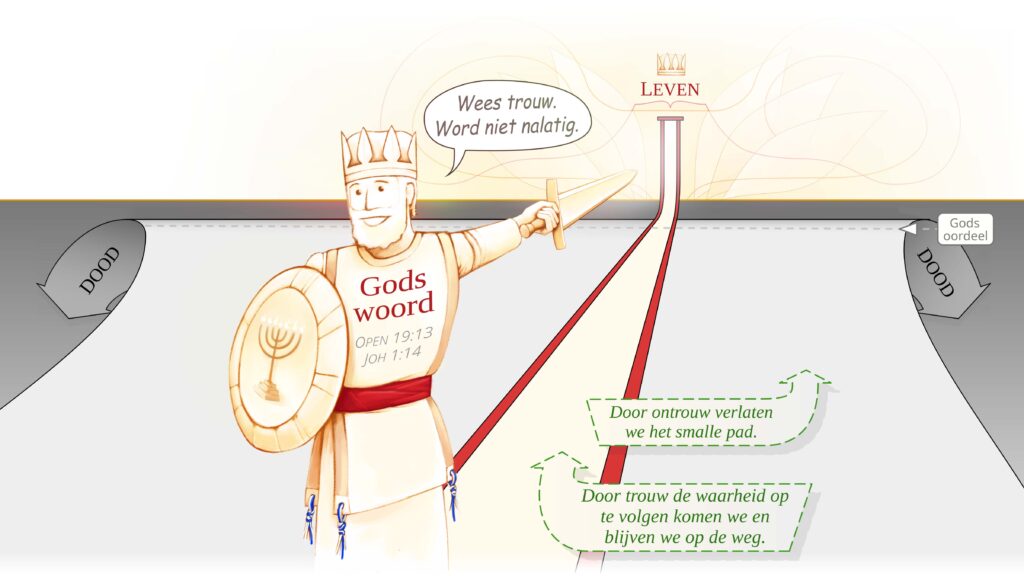
Een belangrijk onderdeel van het evangelie (het goede nieuws) is; dat Gods levende woord geboren is in deze wereld, de ware weg naar het leven heeft verkondigt en voorgeleefd, elke verleiding overwonnen heeft en door God tot Koning en Hogepriester is gezalfd. Jesjoea is de beloofde Messias. Wij worden opgeroepen om ons te bekeren van zonde en onze πίστις (pistis) in Hem te stellen; wat inhoudt dat we God en Zijn Gezalfde vertrouwen en Hem onze loyaliteit / trouw zweren.
God biedt een verbond aan en dat vraagt altijd van de ander om zijn trouw aan het verbond. Als het gaat om een Koning en Zijn heersen over een volk, dan is het logisch dat het gaat om onverdeelde loyaliteit. De Bijbel vergelijkt het verbond ook met een huwelijksverbond; als tussen de Bruidegom (Koning Jesjoea) en de Bruid (Zijn volk / gemeente). Wanneer wij met Hem in het verbond willen treden, dan reinigen we ons om rein te worden als een reine maagd. (1Joh 3:3, 2Cor 11:2, Open 19:7-8) Dan geven we ons woord om heilig te wandelen en aan Hem trouw te zijn tot in de dood. (Open 2:10, 12:11, 1Joh 3:16) Niemand heeft deel aan Zijn verbond door alleen te geloven. Er staan genoeg waarschuwingen in de Bijbel dat als we ontrouw zouden worden, we uiteindelijk uitgespuwd zullen worden in de buitenste duisternis en nooit deel zullen krijgen aan het eeuwige leven. (Joh 15:1-6, Mat 25:14-30)4 Trouw zijn aan God en Zijn verbond kunnen we niet vervangen door alleen geloven (een overtuiging / vertrouwen). Onze verplichting om trouw te zijn kunnen we niet wegredeneren, alsof onze loyaliteit aan de Koning boven alle koningen niet noodzakelijk zou zijn om zalig te worden. Loyaliteit kan alleen door ons worden verwezenlijkt wanneer wij onszelf verloochenen, ons kruis opnemen en de Koning volgen waar Hij ook gaat. (Mar 8:34-35, Luk 14:26) We kunnen niet half of gedeeltelijk onze eigen wil laten heersen, de ‘troon’ over ons leven moeten we volledig aan Hem afstaan willen we werkelijk deel van Zijn Koninkrijk zijn.
(Mattheüs 25:23 HSV) Zijn heer zei tegen hem: Goed gedaan, goede en trouwe dienaar, over weinig bent u trouw geweest, over veel zal ik u aanstellen; ga in, in de vreugde van uw heer.
| De volgende twee Engelse vertalingen kwamen we tegen die πίστις (pistis) in Galaten 3:11 ook met ‘trouw’ (faithfulness / being faithful) vertalen: |
| (Galaten 3:11b Good News of Messiah) “the righteous one will live based on faithfulness.” (Galaten 3:11b Complete Jewish Bible) “The person who is righteous will attain life by trusting and being faithful.” |
Wanneer gezien wordt dat het correcter is om Habakuk 2:4 (en wanneer dit vers geciteerd wordt) te vertalen met loyaliteit, trouw of geloofstrouw, dan wordt ook duidelijk dat op meerdere plaatsen πίστις (pistis) niet vertaald kan worden met alleen ‘geloof’. In Romeinen 1:17 citeert Paulus Habakuk 2:4 als een soort van samenvatting van wat hij daar schrijft. Als Paulus in zijn citaat van Habakuk met πίστις (pistis) onze trouw / loyaliteit bedoelt dan is het logisch dat hij in de zin ervoor met hetzelfde woord niet alleen spreekt over geloof, maar juist over trouw / loyaliteit. Op de volgende manier hebben wij Romeinen 1:16-18 neergezet in de hoop dat de boodschap accurater overkomt.
(Romeinen 1:16-18 BaZ) Want ik schaam mij niet voor het Evangelie (de goede Boodschap / Leer); want het is de kracht van God [die leid] tot redding, voor iedereen die door geloof, getrouw is (πιστεύω pisteuō), eerst de Joden daarnaast ook [voor de andere] volken. Want de rechtvaardigheid van God wordt daarin (het Evangelie, de ware Leer) geopenbaard, uit geloofstrouw (πίστις pistis) tot geloofstrouw (πίστις pistis); overeenkomstig dat wat geschreven is (in de Profeten): “De rechtvaardige zal leven uit geloofstrouw (אמונה èmoenâh| πίστις pistis).” Dit is zo omdat de toorn van God geopenbaard wordt vanuit de hemel over alle slechtheid en onrechtvaardigheid van de mensen, die de waarheid onderdrukken in ongerechtigheid.
Eén van de manieren hoe waarheid wordt onderdrukt in ongerechtigheid is door mensen die zeggen Christen te zijn maar Hem niet trouw volgen. Door bewust te doen wat slecht is, is diegene ontrouw aan de waarheid en onderdrukt hij die in slechtheid. Inplaats van πίστις (pistis) toont diegene het tegenovergestelde; ontrouw (ἀπιστία apistia). Ook deze verzen getuigen dat het ware Evangelie niet alleen een vertrouwen verkondigt, maar duidelijk een geloofstrouw.
(Hebreeën 3:12-14 BaZ) Daarom, wees alert mijn broeders en zusters, dat er niet in één van jullie een slecht hart (denken / redeneren) dat ontrouw (ἀπιστία apistia) zou zijn, en jullie zouden afwijken van de levende God; Maar vermaan elkaar [en blijf jullie zelf onderzoeken] alle dagen, zolang het nog kan, opdat niet iemand onder jullie (binnen het lichaam van de Gezalfde), door de verleiding van zonde verhard (verblind) wordt. Want wij zijn samengevoegd en deel geworden van de Gezalfde, wanneer wij het begin van deze vaste grond (het verbond / de Gezalfde / de waarheid) stevig vasthouden (trouw blijven) tot het einde,
(2 Petrus 3:17 BaZ) Daarom geliefden, jullie die van tevoren gewaarschuwd zijn, behoed jullie zelf (wees alert), anders zouden jullie meegaan in de misleiding van wetsovertreders (de ontrouwen), en daardoor afvallen van jullie eigen standvastigheid (trouw / loyaliteit).
(Kolossenzen 2:5 BaZ) Want al ben ik in het vlees afwezig, in de geest ben ik bij jullie en ik zie met blijdschap de ordelijkheid en de vastheid van jullie ..???.. (πίστις pistis) tot de Gezalfde.
We worden deel van Gods volk door ons te bekeren van onze wetteloosheid en trouw te zweren aan God en Zijn gezalfde Koning, en binnen Zijn heerschappij (Zijn koninkrijk met haar grondwet) te wandelen. Daarvoor moeten we onszelf verloochenen en onderwerpen aan de Koning, en Zijn woord geloven en getrouw opvolgen zoals Abraham. (Jak 4:7, Rom 4:12) Laten we niet alleen ons vertrouwen stellen in God en Zijn Gezalfde maar juist ook onze onverdeelde trouw.
(Lukas 18:8b BaZ) “Echter, wanneer de Mensenzoon komt (om als Koning te oordelen), zal Hij dan ..???.. (πίστις pistis) vinden op de aarde?”
Zoals ook de andere twee woorden: het Hebreeuwse emoenah en het Aramese haymanoetha, is iemand die pistis heeft; iemand die heeft laten zien dat hij betrouwbaard is in het uitvoeren van zijn taken. En is dat niet wat Jesjoea ons probeert te leren?
(Mattheüs 24:45-48a HSV) Wie is dan de trouwe en verstandige dienaar, die zijn heer over zijn personeel aangesteld heeft om hun het voedsel op de juiste tijd te geven? Zalig die dienaar die door zijn heer bij zijn komst zo handelend aangetroffen zal worden. Voorwaar, Ik zeg u dat hij hem over al zijn bezittingen zal aanstellen. Maar als…
Bedankt voor het lezen van deze studie.
Mag de genade van God met je zijn.

Door te klikken op het PDF-icoon hiernaast kun je de volledige studie downloaden. Je kunt die dan offline bekijken of uitprinten.
- Het Hebreeuwse woord ‘emet’ is familie van het woord ‘emoenah’. Dit kunt je ook terugzien in het eerder getoonde overzicht uit het woordenboek “Ancient Hebrew Lexicon”. ↩︎
- Heb. is een afkorting die staat voor:Hebreeuws. We gebruiken dit hier om daarmee aan te geven dat in deHebreeuwse tekst op deze plaats het woord èmoenah staat. ↩︎
- In het boek “Galaten als Zwaard” laten we in hoofdstuk “één eeuwig evangelie” aan de hand van de Bijbel zien, dat voor en na de dood en opstanding van Jesjoea hetzelfde evangelie door God werd verkondigt. ↩︎
- Dit onderwerp hebben we uitgediept inhoofdstuk 6.5 “Geloven zonder trouw / gehoorzaamheid is dood”. ↩︎