
∼ The Study Bible ∼
The goal of the Sword Study Bible
Bible Sword is working on a Study Bible, a tool that shows the entirety of God’s Word as one powerful sword, and provides clarity on exactly where God’s Word cuts. Bible Sword is a project with the goal of…
- …to help each other skillfully use God’s Word as a sharp sword, so that people are cut free from all wickedness and will stand as victors in the battle. (2Tim 2:15) This is an essential part of the discipleship training for everyone who wants to be a worthy disciple.
- …to clearly indicate the separation (the boundary) where the living Word cuts by placing a dividing line in the text, in order to better understand the truth. For when we know where the boundary of God’s kingdom lies, we can share it in truth. This ensures that the many different teachings circulating will not confuse us or unknowingly lead us away from the truth. (1Tim 4:16)
- …to show the unity of God’s message throughout the entire Bible. That the Almighty has one plan and that His plans never fail. That He is one and His Word is one, throughout the whole Bible, from Genesis to Revelation. That the way God proclaimed from the beginning is the same way to eternal life as the way the apostles of the Messiah proclaimed. That we can trust every word that comes from the mouth of God, and it leads us to life.
How does the Sword Study Bible work?
In this Study Bible, we have visually represented the dividing line described in the Bible within the text itself. Thus, you can read the biblical translation while simultaneously observing how God’s Word cuts as a double-edged sword. This dividing line is made visible by organizing the text within a column structure:
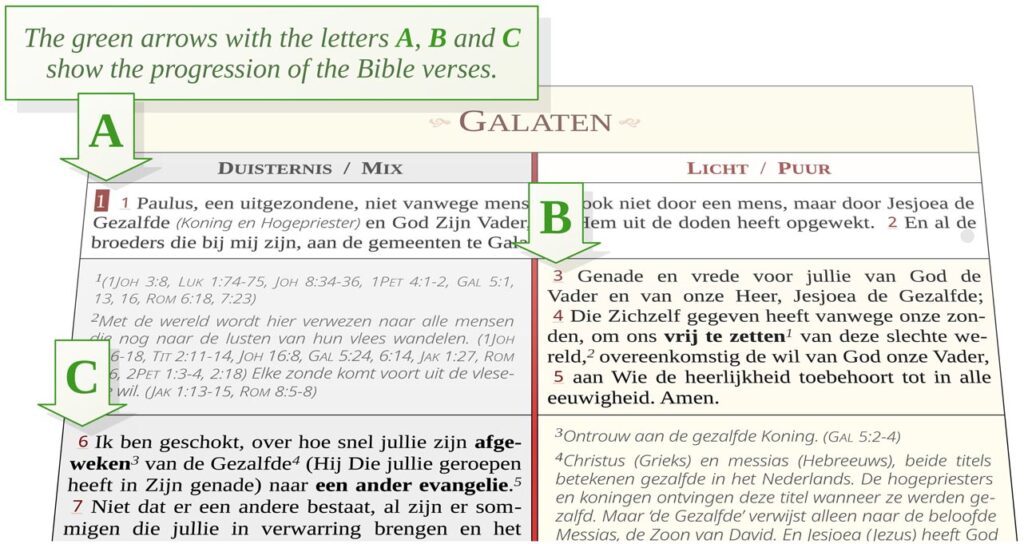
Certain verses are displayed across the full width, as shown in [A]. This first group consists of verses that do not specifically address matters pertaining to either the kingdom of darkness or the Kingdom of light, but are more general in nature. Here is an example:
 Best viewed in landscape mode
 BIBLE BIBLE |
|
|---|---|
| DARKNESS | LIGHT |
| [A] Bible verses addressing general matters are displayed across the full width. | |
| [B] Bible verses in this column address matters pertaining to God and His Kingdom of light. | |
| [C] Bible verses in this column address matters pertaining to darkness and are therefore not part of God’s Kingdom. | |
| DEATH | LIFE |
As illustrated, the verses addressing the Kingdom of light or the kingdom of darkness are divided into two columns. The right column contains words that belong to and define God’s Kingdom of Light, see [B]. The left column contains words referring to matters associated with the kingdom of Darkness, see [C].
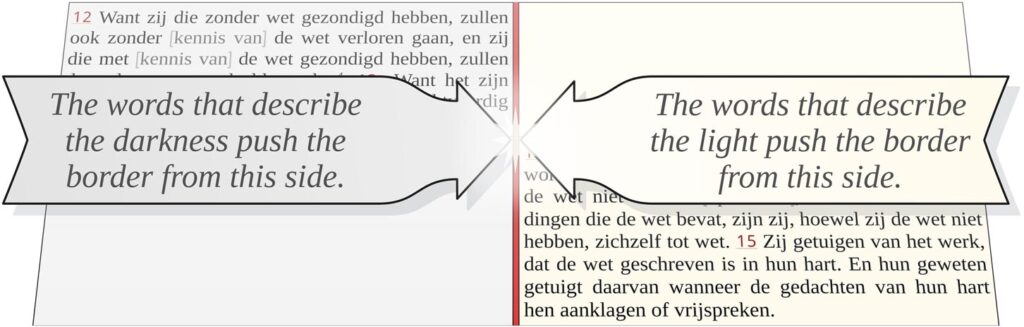
By placing God’s words in their proper positions, God makes the sharp dividing line between Darkness and Light visible to us. By closely examining what the text says, we “zoom in,” enabling us to better discern where God’s Word cuts and how He has defined the boundary.
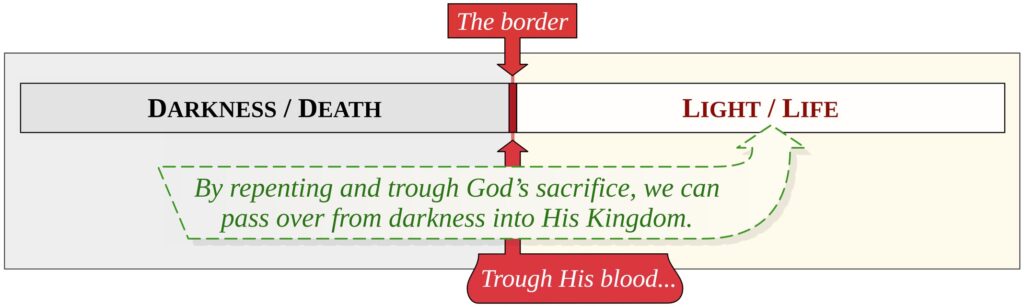
Why the red line between the two columns? Because humanity has fallen into sin and turned away from God, we lack the indwelling of God’s Spirit from birth; therefore, each of us must be born a second time, of the Spirit. (John 3:5-6) Consequently, we are all called to repent of our sins (the works of darkness), to emerge from that darkness, and to cross the boundary into God’s Kingdom of light. (Rom 13:12, Eph 5:11, John 3:19) However, our repentance alone cannot reconcile us with a holy and righteous God. Forsaking our sins brings us to the border of His Kingdom, but it cannot carry us across the boundary. Ceasing evil and doing good cannot rectify or pay for the damage our sins have caused to God, others, ourselves, and His creation. To allow one who has repented into His Kingdom of light, the Most High had to provide a worthy Sacrifice capable of bearing and paying the debt of all our sins.
The value of this great Sacrifice, which can save us from death and reconcile us with God, the Giver of life, surpasses all understanding. Therefore, the blood of God’s beloved Son is by far the most precious possession we can attain. This is why we indicate the boundary of God’s Kingdom with a red line, referring to the precious blood of God’s Lamb that had to flow to ransom humanity and enable us to cross from one kingdom to another—from Death to Life.
Occasionally, a verse may address both light and darkness, yet we have categorized the verse into one of the two columns. When we make such a choice, we do so because we believe it best serves the author’s intended message. We have endeavored to categorize the text to the best of our ability; however, this does not imply that alternative interpretations are not possible. By visually organizing the biblical text, we aim not only to demonstrate where God’s Word sharply discerns but also to provide an example of how you too may utilize God’s Word. We hope to encourage others to engage with the biblical text in this manner. It is an effective method for Bible study, fostering growth in spiritual discernment and the knowledge of God’s will.
The study assistance provided by the Sword Study Bible
By dividing the text into different columns, this tool can assist you with the following:
God’s message becomes clearer as the boundary between darkness and light, death and life, is more distinctly emphasized. It provides better insight into what pertains to the path of life versus that which leads to death. Complex subjects are presented in this manner to be more organized and accessible. Furthermore, the frameworks within which matters should be interpreted become more evident, allowing erroneous interpretations to be identified more readily. Consequently, ambiguities and doubts dissipate, strengthening one’s steadfastness in faith. Studying verses from a single column can also be very enlightening for understanding their mutual connections. For instance, in the Epistle to the Galatians, it helped us more easily identify which matters Paul connects to describe a problem, as well as the points he emphasizes that collectively form the solution.
We hope you will experience these benefits when using the Study Bible. May it serve as a professional tool in your hand, assisting you in testing and applying God’s life-giving words.
Explanatory notes and cross-references
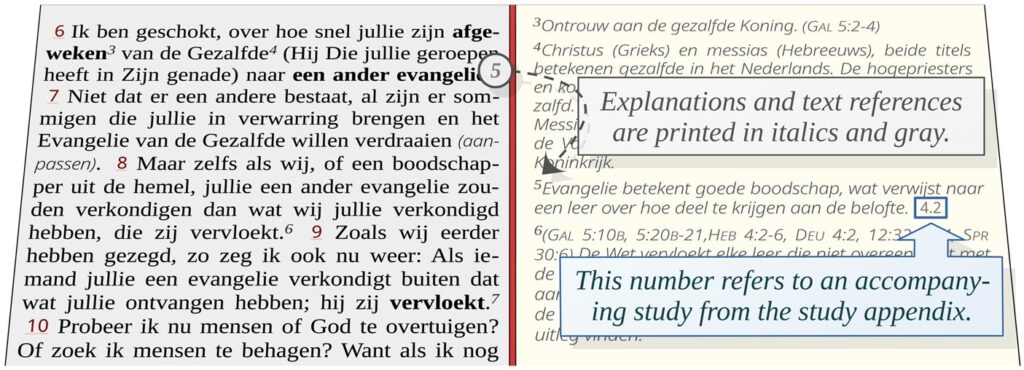
As shown in the following image, we have included explanations (commentaries) and cross-references alongside the biblical text to provide further clarification. These are displayed in grey italics. Some explanations include reference numbers pointing to a corresponding study where the topic is elaborated upon. These can be found after the biblical book, further along in the volume. The purpose of these explanations and studies is to assist in better understanding the biblical book and God’s message. You are not required to agree with them, but please test all things and hold fast to what is good. (1Thess 5:21-22)
About the translation
This Study Bible is not a new translation from the original languages. For this translation, we have used the King James, ASV, YLT and the Dutch Statenvertaling as a basis, converting the archaic language into more contemporary English. In doing so, we have consulted various source texts and made adjustments following thorough research. For the Renewed Covenant1 (the writings of the disciples), we utilized Aramaic and Greek texts. By illuminating the text from two different languages, we are provided with a unique opportunity to verify the translation of one language against the other.
Our perspective on and interpretation of Scripture
We believe in a perfect God who has given a perfect Word to humanity. Every letter that God caused His writers to record was and is His, directed by His Spirit. (2Tim 3:16, Deut 32:4, Psa 102:28, Matt 5:48 & 19:17, 1Sam 15:29, Isa 26:4, Mal 3:6, Num 23:19, Rom 1:9, Jas 1:17)
Although the original manuscripts are no longer extant, we fortunately possess various copies, and translators strive to render them as accurately as possible. However, a translation has its limitations. Not every original word is easily translated. Sometimes, contemporary language simply lacks a similar term, or a certain concept is unknown in our culture. Knowledge of Biblical / Hebrew culture is therefore essential. When words, concepts, or customs from our Western culture do not align in meaning with the Biblical culture, they distort and misrepresent God’s intent. For example, two people may discuss a concept like ‘father,’ but if they do not share the same understanding of it, they may fundamentally misunderstand one another.
Furthermore, the difference in thinking between modern Western culture and the Hebrew culture of biblical times sometimes complicates translation. Bible translations are influenced to varying degrees by the culture, skill, and spiritual state of the translators.
Despite these difficulties and imperfections, a Bible translation can still be an essential aid in seeking and learning to understand God’s message. Our translation also has its flaws, yet we hope it may serve as a helpful resource in this endeavor.
We believe that by departing from our Western culture in thought and action, we can change and grow toward God’s culture, so that our eyes are increasingly opened to His intent for His Word. Through the Word and the Spirit of God, we can learn to see from His perspective and understand His message in truth. In this way, truth renews our thinking and conforms us to His image. (Rom 12:1-2, Eph 4:17-24) Just as Abraham had to leave his country and family, we too must leave our own “culture” and “kingdoms” to cross over into God’s Kingdom. (Matt 6:33, 7:7-12 & 10:37-39, 19:16-29, Psa 37:3-5, Luke 12:32-34, 14:26-33, Mark 8:35, Luke 9:24-26)
In this manner, we strive to adopt and apply God’s culture in our translation and studies, conveying His message in truth from His perspective. The studies “The Righteous shall Live by ..???..” and “Distinguishing the true Christ from an antichrist” further illustrate our view of and approach to the original texts.
The name Yeshua instead of the name Jesus
“Yeshua” is a transliteration of the Hebrew name ישוע (Ye-shoo-ah). This is the name given to His Son not by man, but by the Most High. (Matt 1:21, Luke 1:31, 2:21) It is a conjugation of the Hebrew verb ישע (Ya-sha), which means to deliver, liberate, or save. The Hebrew name ישוע (Ye-shoo-ah) means: He delivers or He will deliver. Because God determined the name Yeshua and its meaning with a specific purpose, and because we wish to testify to the world that God caused His Anointed to be born into this world from the Jewish lineage—the promised Son of David—we choose to use the name Yeshua.
Work in Progress
With great passion and zeal for the King above all kings, we have dedicated ourselves to passing on the best of what we have received. We have endeavored to articulate important matters and insights to serve where we perceive a need. Our desire is that many will be helped to know the true message of God without dilution. This is the goal we strive for, continually testing and refining everything.
Regrettably, we cannot claim that we make no mistakes or that our work is perfect. Nor do we possess all wisdom and insight. Therefore, we remain open to corrections and any assistance others may wish to provide. We realize that we need one another, just as the various parts of a body need each other and work together. God moves His servants to collaborate as His people and the body of His Anointed King. By sharing this project with you, we reach out to ask if you feel moved by God to contribute to this endeavor. This can be as simple as a comment or observation; anything for God’s glory is welcome. This Study Bible is therefore still a work in progress. You may contact us via the contact page or our email address: info@Bible-Sword.org
- In our view, the title New Testament is not an accurate designation, as the covenant in the blood of Yeshua the Anointed is, in fact, the covenant made with Abraham, which is also referred to as the eternal covenant. This covenant had to be, and was, confirmed by Yeshua through His blood. God added the Sinai Covenant to the promise; it is not in conflict with it but rather works in conjunction with it. Furthermore, the Sinai Covenant remains in effect today. For this reason, we refer to the writings of the disciples of Yeshua as “the Renewed Covenant”. This is further explained in the studies of Chapter 3, particularly in Chapter 3.3, “The Promise and the Renewed Covenant“. ↩︎